Sunday, September 19, 2021

Saint John Bosco and the Dog Grigio


 The latest story for my book is about the beloved St. John Bosco, an Italian priest who lived from 1815 to 1888.  One of the big differences between this story and the others in this collection is that most of my information for this story came from neither hearsay nor legend nor hagiography.  It was from the pen of Don Bosco himself (Don is the Italian title for a priest).  He wrote extensively.  I haven't had time to read all his writings, but I did find out from him about the wonderful, possibly angelic, dog that protected him in the times when he needed protection.   

This picture is of  Don Bosco as a newly ordained priest, in the sacristy where a shivering, underdressed teenage boy is trying to escape from the cold on the one hand, and from the broom of an unhappy sacristan who doesn't want young ruffians in his holy domain.  Don John knows that his own ministry is going to be to boys, and he recognizes this scruffy lad as his first.  

This is before the dog comes into the priest's life, but I had to describe what kind of person he was.  He was a man who loved before anything else, and he knew to whom he was dedicated.  His boys were the reason for, and the center of his life.   

Monday, June 22, 2020

St. Melangell and the prince

Wales.  6th century.
Melangell is praying in the woods where she lives as a hermit.
Prince Brochwel is hunting on his land, annoyed because he has been out all day without running across any game.
Finally, late in the day, the dogs catch the scent of a hare and give chase.  But what gives?  The hare is hiding in the folds of Melangell's dress, and the hounds, cowed by her peacefulness, refuse to do what they have been brought along to do: grab that hare.

The density of the greenery was fun to play with.  The dogs are taken from modern hunting dogs.  It is likely that sixth century hunting dogs would not have been as uniform in size and shape as the ones they breed now especially for hunting particular game.
The prince would have hunted with a bow and arrow, but would have had a knife, and possibly some other tools as well.  He seems not to have taken a servant with him on this expedition.

Melangell is a true woman of God, and her prayer is so deep that she is unaware of the dogs, or the approaching prince until he accosts her.

May I learn to pray like that.

Thursday, February 13, 2020

St. Modomnoc published in the Valyermo Chronicle

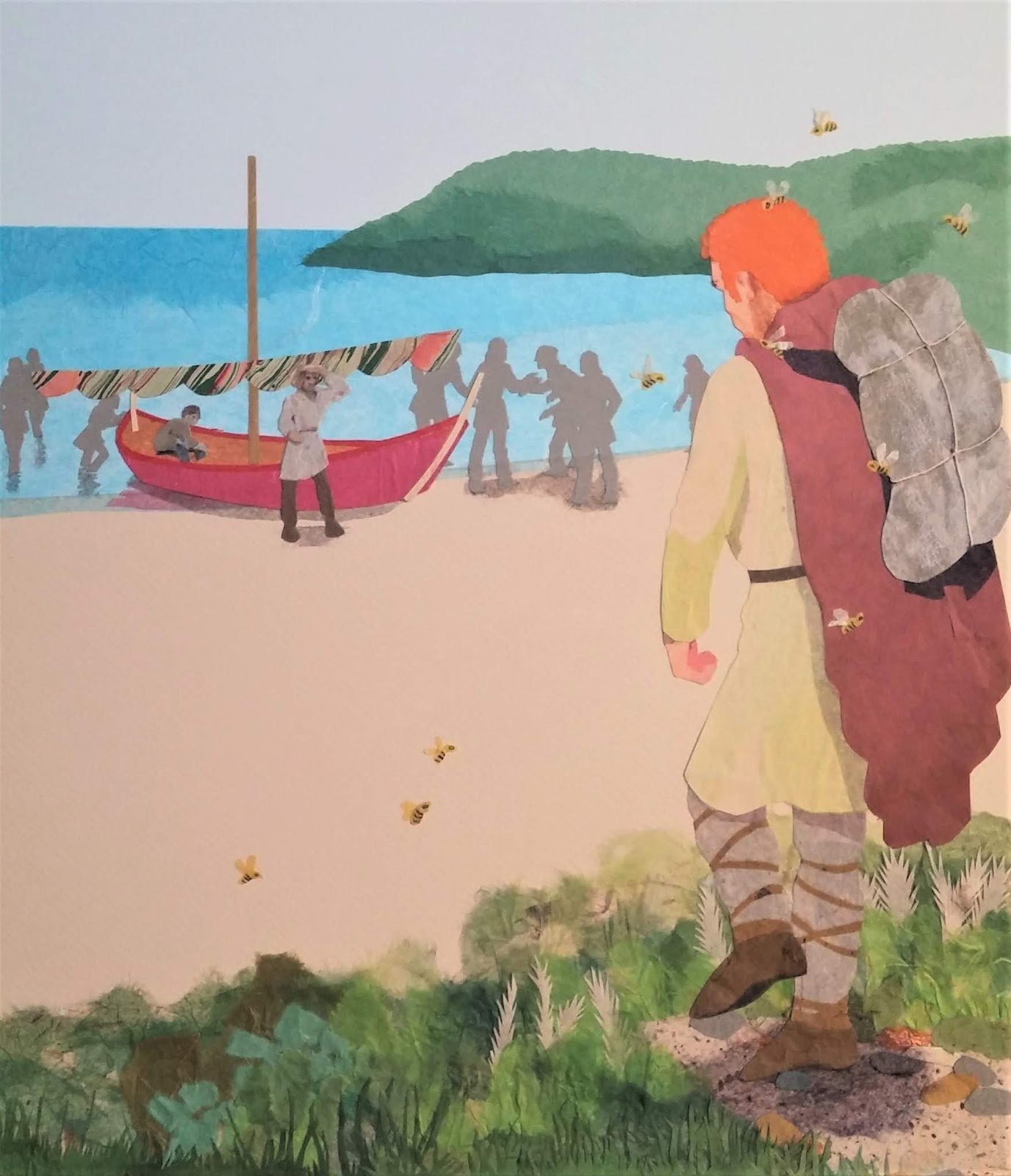
Modomnoc on his way to the boat that will carry him home to Ireland
It's nice to have some of my stories published, even if they are not exactly in the format I set them up for.  Fr. Aelred, who puts together the quarterly magazine for St. Andrew's Abbey, was asking one day if there were female oblates who had work to put into the magazine.  I happened to be there, and asked him if he would entertain the idea of stories, rather than nonfiction articles.  He said Yes, and to send them to him electronically.  When he received them he said he would very much like to publish one.  So that happened last summer.  Then before Christmas he said he would like to put another one into the Winter issue.  I had to scurry to get pictures ready, but a deadline is always useful.  I got this picture and one other done for the Winter issue, to go with the two pictures already finished.

The magazine arrived in our mailbox yesterday.  Considering that the format I planned on is a book with 8.5" x 10" pages, and the Chronicle pages are 5.5" x 8.5", the words and pictures came out quite well.

This is the story of St. Modomnoc, a 7th century Irish lad who goes to Wales to study for the priesthood, and is made beekeeper for the abbey.  He makes such a deep and loving connection with the bees that when it is time for him to go back to Ireland,  all the bees follow him there.   

This image is of a specific place in Wales, a beach near Menevia Abbey where Modomnoc studied. It seems like the most likely place where Modomnoc's boat would have left from. 

Saturday, January 25, 2020

Illustrating

Illustrating a story is different from making a picture, which is different from being a good draw-er.  I was always a good draw-er, so I thought I could illustrate.  It turns out that the essential skill is only the first step, and not even absolutely necessary at that.  In fact, it can be a detriment because a person who is confident that their work looks good may tend to lean too heavily on how attractive the image is, and not delve into the internal issuesof storytelling.  How does the picture express the feel of the story?  How does it tell something that the words don't or can't tell?  How does the picture fit into the placement of text on the page?  How many pictures does a story need?  What events in the story do you choose to illustrate?  How do you make each page beautiful in itself?  (That was one of Seth's main considerations when he was making his comic book pages.)

It has taken me ten years of struggling with the process and the discipline to even begin to formulate these questions.  Clearly I am a slow learner.

But little by little I am making images for the stories I want to tell, and putting them together.  It's only by actually DOING that a person learns these things.  Without doing it, I think you always think that the rules don't actually apply to you.  You think your work is above, or at least outside the rules.  Learning humility seems to be a vital part of this process.
Here's an illustration for the story of Martin de Porres and the mice.  Initially the picture did not have pots or shelves in the background, and Martin did not have the tonsure (that peculiar monk's haircut).  I was just throwing out pictures for certain segments of the story, without seeing how it all fit together.  But, then I reread a book I have on Martin, and rewrote the story so that it was more true to his life, and was going to toss this picture.  I did however like the structure of the picture, how his finger and the mice are all pointed toward one place, and decided I could still use it if it were altered.  
Now it seems to fit better as the final image in the story.  

From now on, however, I'd like to make most of the images blend into the page a little bit more, and not be so very rectangular.  That's Seth's influence.  

Sunday, April 14, 2019

Roxy and the Crows

Crows are smart and funny.  They are also very social beasts, and they take care of each other.  I heard a story from a driver who witnessed this event, about a group of crows in the street, clearly distressed, who flapped and cawed, beseeching the driver of the car not to proceed until they had moved an injured crow to the side of the road.

For a project for an illustration class, I did this picture for an as yet unwritten story about our next door neighbor Roxy who is about seven years old, and St. Benedict's Prep School in Newark, NJ, and an injured crow.  Benedictines are great; I am a Benedictine oblate myself.  They have a serene way of understanding that good things take time and practice.  This school is a modern miracle, an educational oasis in the middle of downtown Newark.  And Roxy is so full of energy that it was hard to picture her sitting still, though she is an animal lover, and so I am pretty sure she could do it if a crow's well-being was at stake.


Here is Roxy in a more characteristic pose, twirling in joy. 


Wednesday, July 4, 2018

Naming the Animals

Adam names the animals

God loves to create.  He made animals of shapes and color combinations and processes that we could not have imagined.

At an illustrators' workshop a few years ago I met Iain McCaig whose job it was at that time (I don't know if it is still his job) to design monsters for George Lucas.  Design creatures: what a job!  Talk about playing God!  Because it's a monster, by definition a creature unencumbered by reality, the boundaries are wide open, and one is limited only by imagination.  Iain showed us how he freed his mind from the strictures of an unimaginative day or not enough caffein that morning.  He led us through a process that used objects at hand to reimagine as monster parts, and challenged us to design our own monster.  It was great fun, and when we were finished I had drawn a creature that I would not have imagined without using his method.

God did it (does he still do it?) his own way, from scratch.  There is a niche that needs a creature, and he finds a way to fill it, always with panache. 

Adam in this picture has not yet eaten the awful fruit.  He is a simple, straightforward, guileless man who has been given the joyful mandate to give names to all the animals as they parade before him.  He gives them names and so asserts his stewardship over them. 

I tried to include in this picture as many genres of animals as I could without getting confusing, and still have an elephant as the centerpiece.  (Could a picture of animals in general NOT include an elephant?)  So there are mammals, birds (one extinct), reptiles, and an insect.  They have to stand in for all the animals that are outside the border of this picture. 

Thursday, October 20, 2016

Cut paper art


It has been nearly a year since I've posted anything here, so maybe it's time to put up a representative sample of the kind of work that I've done lately.  This is St. Martin de Porres, a Dominican monk from Peru in the early 16th century, a man of prayer who was known as a healer, but did not stop there.  He also cared for animals large and small.  The most famous small story about him concerns some mice that had overrun the monastery.  He invited them to live outside the walls in a place he designated, and they followed his suggestion, solving the monastery's problem while doing providing the mice with a proper home.

Working with cut paper is quite a different process from any work where one fills in a drawing with color from a brush or pencil.  First of all, there are the many gorgeous papers to choose from. Textures, colors, varying translucence, the papers bring their own personalities to the work.  It's like working in collaboration with a group of artists who all love beauty.

Then the size of the picture makes a difference.  I can't do details that are too fine; they would just be lost.  I have found that just redoing a watercolor picture in cut paper doesn't really work well.  The sort of image that watercolor does best is quite different from the sort of image that cut paper does well.  Sometimes there is energy in a scene that I would not have been able to express in watercolor, but can do with cut paper.  Perspective doesn't seem to be as big an issue with these works; they will never be photorealistic in any case; I can let them suggest rather than show the action.

This work to me now is a pleasure and a joy.  I hope that translates to others.  

Sunday, November 15, 2015

Collage

After doing about fifteen or so watercolor illustrations for stories about saints and animals, I got fed up because it was so laborious every time.  I would continually find other things to do than to face the unfinished page that was sitting on my work table.
When I had a personal sort of project to do however, like a birthday card, I would find some pieces of colored paper, cut out shapes, and make a picture out of them, bang, bang.  No matter how complicated or time-consuming these cut paper projects are, I head to the art table to work on them whenever there is a spare moment,
For example:
This one on the left is the card for Tofu's birthday this year.  The boy (Tofu, of course) has a wheel behind his feet so that he can move fairly easily up the path to the top.
It was so fun to make.
I have been making cut paper collages since I was in college, always for fun.  I never considered them serious art.
Why not?

Finally a lightbulb went off! Maybe I could do the art for my book in a medium that I truly enjoy...
What seems Real about this process is that the layers are truly layered: the background is in the back and the foreground objects are pasted on top. What's more, each color is its own discrete entity.  It makes sense in a simple-minded, literal sort of way.  For some reason that seems thrilling.  Also the textures of the papers add an organic beauty that I couldn't have invented.  And the clean edges are, well, clean, crisp.  

So I am starting over from scratch, doing cut paper pictures instead of watercolor ones.  
In order to finish this project in my lifetime, I'll cut down the number of pictures, so that each story will have three at the most, instead of about eight.  
I posted earlier the watercolor that this one is replacing which can be seen here.  

I suspect that I am an engineer at heart.


Sunday, August 2, 2015

Abbey sketches


We spent the weekend at St. Andrew's Abbey.  I always take my little watercolor sketchbook; this is one of the few places where I actually use it. There are no telephones there ringing for me, no computer, no laundry, no meals to fix: only lessons about God and prayertime with the monks, and walks. So there is time to paint when nothing else is calling me.

Each of these little sketches took about an hour.

There are many turtles in the pond, red sliders, the kind kids keep in those little plastic kits until they get tired of them.  I guess someone brought one or two here because the abbey's pond is quite big, a small lake really, and the turtles thrived and multiplied.  It's funny how they pile up on top of one another on those rocks in the afternoon sun.  They don't seem to mind close association with each other, even to being used as benches.  Some of the rocks seem as though they would be too steep for creatures as clumsy as a turtle to climb up, but we watched one of them sitting on a rock at about a 45 degree angle for a long time, until he finally slid back down into the water.

In the pond also are some very large koi, some smaller gold fish, or goldfish, frogs that sing on summer evenings, and a flock of ducks. The ducks are the descendants of a pair of mallards and some white ducks, hybrids that have mallard markings in a tan color.  They live here year round, coming toward me when I walk down the path, but scuttling back to their posts at the water's edge when they see that I have brought them no food.  

Wednesday, October 29, 2014

St Spyridon and the Poor Farmer and the Snake

I finally finished the story whose title is the title of this blog post.  It is about St. Spyridon, a fourth century bishop of Cyprus, greatly beloved in the Eastern Orthodox church, a man both kind and down-to-earth, and a wonder worker.
The picture here is the last one of the story, and contains all three of the title characters.

According to the story (one of many told about St Spyridon), during a drought in Cyprus, the supplies of wheat dwindled so far that even the vendors, who bought wheat from the farmers and then sold it to others, ran out.  Only one vendor foresaw that scarcity meant high prices, and bought up all the supplies himself.  Eventually he was the only one with wheat to sell, and he raised his prices to the moon.  One poor farmer tried to borrow wheat from him, saying that he would pay it back with interest the following year, hoping for rainfall and a good year.
The vendor slammed the door in his face at that suggestion.  The poor farmer then went to see St. Spyridon, hoping at least for a kind word.  He received a kind word, and encouragement to hope in God.  The following day, St. Spyridon visited the poor farmer with a chunk of gold.  He told him to go to the vendor, and with the gold as collateral, to borrow wheat to plant and to feed his family. Spyridon told him to be sure to bring the gold back the following year when he had repaid the vendor.  The farmer did as he was told.  The greedy vendor gladly lent him the wheat in exchange for the gold, knowing that there was no way he would be able to repay it.  But the following year the rains were plentiful, and the poor farmer had a bumper crop of wheat.  He returned to the vendor with a large sack of wheat--enough to pay his loan with generous interest.  The vendor reluctantly returned the gold to him, and the farmer took the gold back to St. Spyridon.
The saint said to him, "Come, let us return the gold to the one who lent it to us," and he led him out to the back of his own garden where he set the gold on a rock, and prayed to God.  The gold turned into a yellow snake, which slithered away.  
The poor farmer then fell on the ground and covered his face, saying, "I am not worthy of such miracles!"  But Spyridon gently lifted him up and said that for those who are humble of heart and ask him, God is pleased to work all kinds of wonders.

Among the stories of saints and animals, I chose this one because it is an unusual story because the animal in question is a reptile, a snake redeeming his kind from the bad press generated by the snake in the Garden of Eden.  It is an unusual sort of miracle too, whereby an animal gives its life temporarily for use by a saint, a gesture that is kind without being warm and fuzzy.

This is the first story where I put the words into form on the pages and then made the pictures to go into the spaces I determined for them.  That is clearly the way to do it.  People who take classes in this sort of thing probably learn this on day one or two, but when you are doing it all by the seat of your pants, as I am, it takes much longer to figure out.  But that's OK.
I am ready to begin the next story.

Sunday, June 22, 2014

Anniversary at the abbey

We spent our anniversary at St. Andrew's Abbey, an anniversary destination that has immediately become a tradition.  Why didn't we think of it before?  It is a place we both like to be, for the prayer, the quiet, the monks with their ordered, present, happy lives, the bookstore (for Bob), Seth's grave (for me), the dry, grey-green beauty of the high desert, and the chance to go striding about in the hills.  I can paint there undistractedly, small desert landscapes that have no purpose except as exercises in putting on paper what I see.
This little painting was done in one of those 5 1/2" square Moleskine knock-off books, with a tiny watercolor box, and a couple of paintbrushes that hold water in a reservoir in the handle. Lightweight and easy to carry about, and fast to get started and clean up.

I started the first afternoon and went back to finish the following morning.  Bad to do if you are an Impressionist, but I'm not, and I was quite satisfied with the colors.

As I sat in the sand, I was accompanied both times by a small creature rustling about in a cluster of dry bushes nearby. It could have been a family of quail, or possibly a squirrel, though usually both of those appear at some point as they dart about doing their housekeeping. Whatever it was, it scratched and scrunched in the brush the entire time I painted, with noises so regular that it seemed as though it must be building something: maybe a palace just the size and form to suit the builder and its family.  I kept hoping it would appear, but it was evidently as consumed with its work as I was with mine, and had no interest in meeting a large intruder from the world of humans.  So the small creature and I concentrated on our work, side by side, each perhaps dimly aware of the other, but each with our own project to complete before the time came when it had to be finished now or never.


Tuesday, January 28, 2014

St. Seraphim, second round

St. Seraphim needed a better picture than the last one, and he needed another post.

Regardless of how this picture looks, he was more than a guy who had a bear for a buddy. The reason for the bear's interest and lack of normal animal-human antipathy was that St. Seraphim had immersed himself in prayer to such an extent that his soul had lost its odor of corruption, if I may put it that way.  He seems to have purified his soul so that he was able to live as in Eden, in harmony with the natural world.  The famous passage in Isaiah says that "the wolf shall dwell with the lamb,...the cow and the bear shall graze,...and the lion shall eat straw like the ox."  Fierce creatures will be gentle, and they and humans will not fear each other.  These prophecies seem to come to fruition in the lives of people who devote themselves entirely to prayer.  And St. Seraphim was one of those.
A quotation from St. Seraphim:
"You cannot be too gentle, too kind.  Shun even to appear harsh in your treatment of each other.  Joy, radiant joy, streams from the face of him who gives and kindles joy in the heart of him who receives.  All condemnation is of the devil.  Never condemn each other."

Ah, that is the kind of world I would like to live in.


Thursday, January 2, 2014

St. Seraphim

We spent last weekend on retreat up at the monastery that we love: St. Andrew's Abbey.  While we were there, I told someone about my plan for a book about saints and animals, and she said, "Well, there's Saint Seraphim and the bear..."  So when I got home I looked him up.
Saint Seraphim was a Russian monk who lived in a monastery, but in order to spend more time alone in prayer, took to staying in a small hut in the forest near his monastery.   He died in 1833, so he began going to the forest about the same time that Russia was at war with Napoleon.  Now Bob and I are reading WAR AND PEACE, and the War in this case is that war with Napoleon.  The Peace in the novel is a story of the social comings and goings, loves and trials of some fictional  Russian aristocrats.  For me there is something of a cognitive dissonance in the realization that this peaceable, prayerful man is the historical person, and the scheming, hoping, worrying, planning, good and bad motives and activities of the Bolkonskis, Rostovs, and Bezukhovs is fiction.   Tsar Alexander (who makes several appearances in the novel) was one of the people who visited St. Seraphim at his forest retreat.
The account of the bear is not really a story; it is just that while St. Seraphim lived in his hut in the forest, he was visited by many forest creatures whom he welcomed, as he welcomed all beings created by God.  An abbess from a nearby convent came to visit him one time and was terrified to see a huge bear with him.  But Seraphim told her not to worry, the bear wouldn't hurt her.  The bear was seen with him on various occasions.  He fed the bear with his bread, and was brought gifts of honey from the bear as well.

This little picture is a 5"x 7" card that I painted to send to Tofu, to tell him about this lovely, holy man.  His feast day, it turns out, is today, January 2.

Sunday, November 3, 2013

St. Gerasimos, the Lion, and the Donkey

This is a lovely old story, a legend about a saint who is a favorite in the Eastern Orthodox church.  St. Gerasimos is out walking in the Jordan River valley, when he comes across a lion, limping and holding one paw up pathetically.  The lion holds his paw out to the saint, who sits down, examines the paw, removes a large thorn, and binds up the paw with a clean cloth.  Then the lion follows him back to the monastery and stays there, whereupon the monks give the lion a job.

I won't tell the whole story here, (You can read about it here.) but I retold it, painted three illustrations for it, and it has been published (with one illustration) in a small Catholic children's magazine called St. Mary's Messenger.  The story is in the Fall 2013 issue, which just came out.


Monday, July 8, 2013

More English reading lessons for Tofu

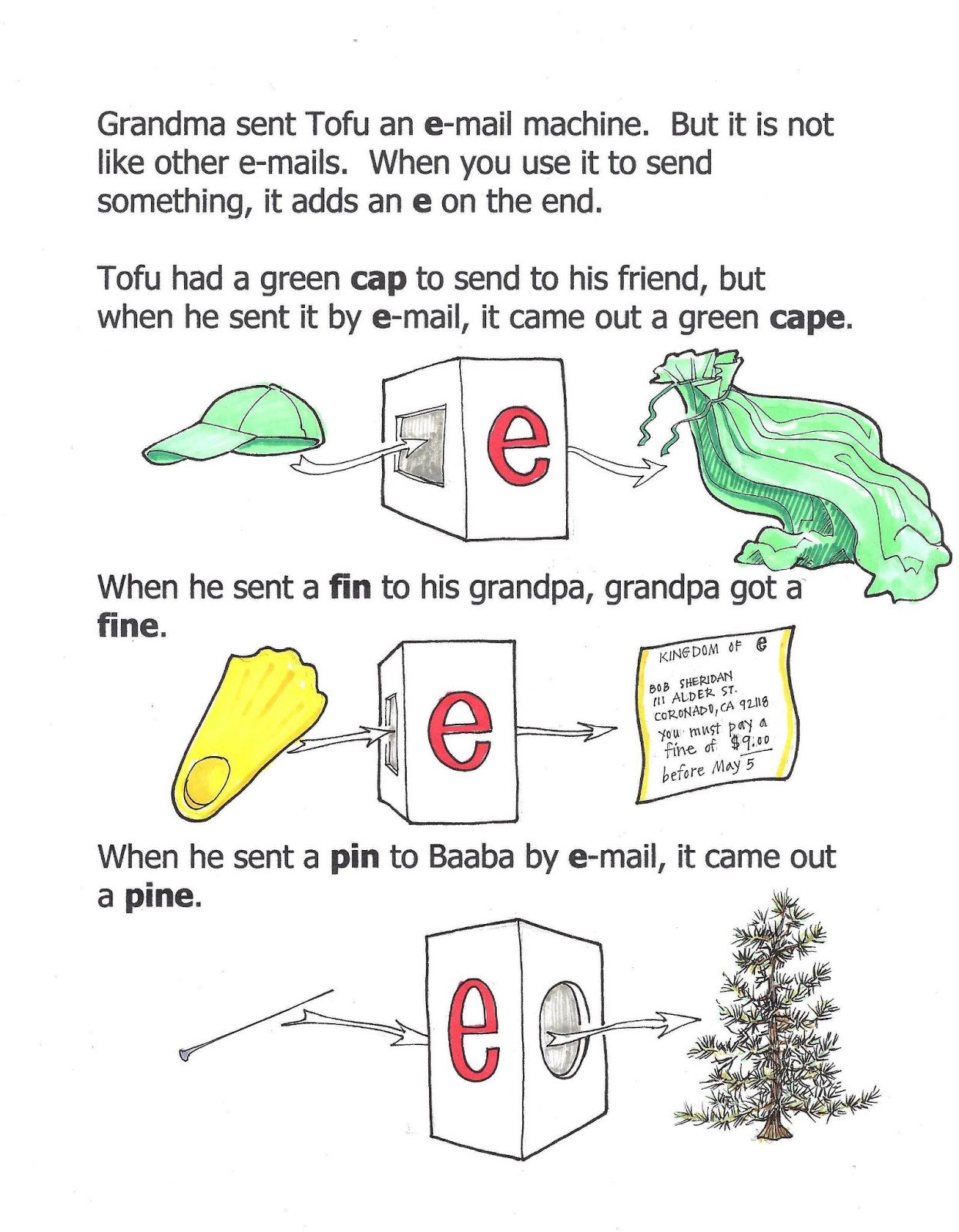
 As Tofu's Japanese reading gets better and better, it becomes harder and harder for him to put himself through the effort of reading English, in which the pronunciation of the words is not necessarily obvious, and the content is necessarily somewhat elementary, since his reading vocabulary is so much smaller than his speaking vocabulary, and smaller yet than his thinking processes.

And of course eventually he will learn to read English in school, since Japanese schoolchildren do learn.  But he will learn from someone whose English skill is far less than his own.

So I think that it is a challenge well worth our effort, Tofu's and mine, to keep working on English reading. My challenge is to make lessons that are fun, not too simplistic, that he will enjoy enough to look forward to--not dread--letters from Grandma.  His challenge is to read them.

This particular rule, about how an "e" on the end of a word makes the vowel say its name, is one that he actually already knows.  But occasionally he stumbles over it, and so I thought it was worthwhile to make a whole interesting lesson on the subject.  Besides it was quite fun to find words that worked for this exercise.                                                                      

Tuesday, April 23, 2013

John 14:23--29

This drawing was done for the Sixth Sunday of Easter gospel, in which Jesus tells his disciples that he is going away, but he will send the Holy Spirit to be with them.

It is meant to go on a folded sheet of letter-size paper, and printed 5 inches tall.

The readings for the season of Easter are all from Jesus' discourses in John's gospel.  They are all rather non-visual, a challenge to find an image for.  For this one, I decided on showing Jesus with the door through which he is going, though his hand could be reaching out in a gesture to his disciples as well as to the door handle.  

Tuesday, January 8, 2013

Good Dog

The Chinese (not Japanese) characters behind the boy say "Good dog" (at least that's what I hope.  The left hand one is Good and the right one is Dog.  If they would use a different way to say it in Chinese, I wouldn't know.).  This was the initial painting for a book that I am hoping to finish the illustrations for this year.  It's a true story of finding a puppy lost and cold on the streets of China, and bringing her home to America.

In fact, however, I don't expect to use this picture for the book.  I'd like the actual drawings to be somewhat simpler and flatter.  Also, the format will be different from this, with square pages.  So the image to illustrate this page, where the boy explains to the now grown-up dog that she came from China, will be a double page spread, twice as wide as high, and the text will be incorporated in the picture.  

But I liked this image.  I used my former next door neighbor boy Tate as a model for the boy in the picture.  He patiently posed for me, holding a stuffed dog and talking to it to try & get in the mood.

Monday, December 17, 2012

Gloria in excelsis deo

Glory to God in the highest!
(It sounds more glorious in Latin though.)

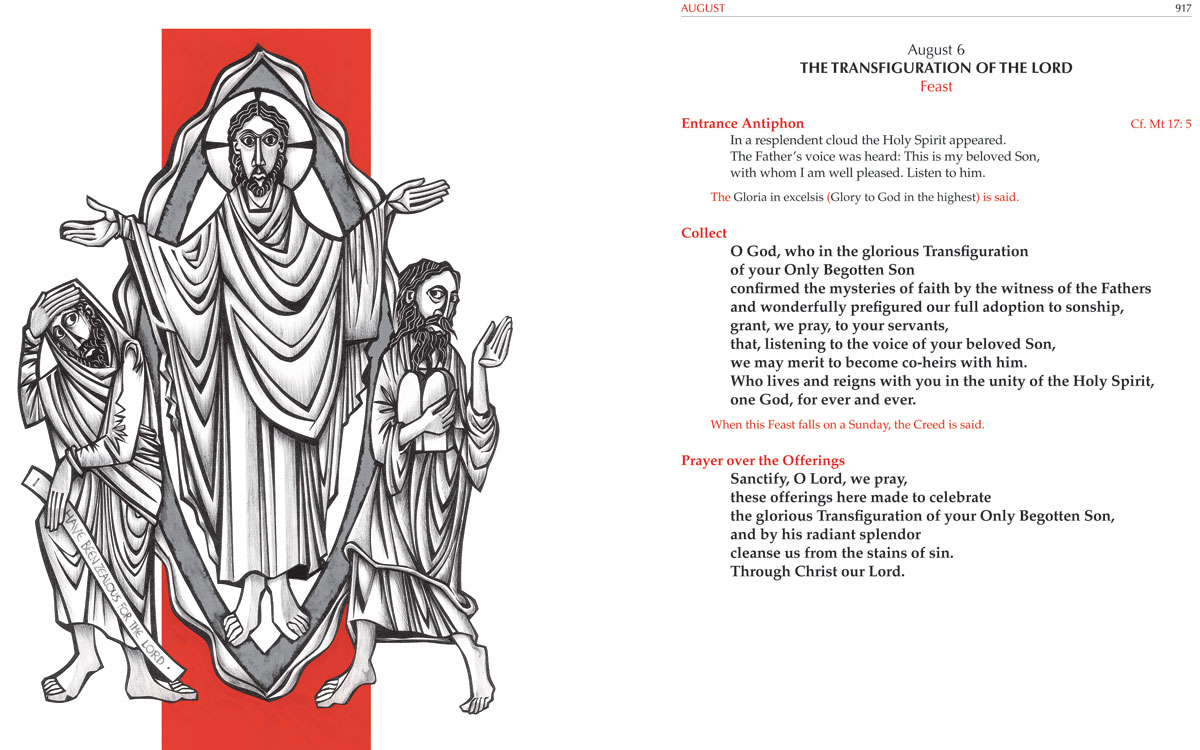
This image was done in an effort to make the sort of small, iconic drawings that can be found in books of liturgy, drawings that are meant to symbolize, rather than explain, a text.
I love the drawings by Br. Martin Erspamer, OSB, which are often found in Catholic liturgical guides.
I am not sure my particular style is suited to such a use, but how can I know unless I put enough true effort into the making of them?
I've done a few more, but this small one is the only one related to Christmas.  

Tuesday, December 4, 2012

Hiking by a stream

In the interests of helping Tofu read English (his Japanese reading is super, but he has much less opportunity to practice English), I have been sending him little stories, with pictures to go with them.  This picture is for a story about a boy named Tofu and his fictional canine friend Jonny, spending a cool Saturday morning floating dandelions down a stream to see which ones go the fastest (incidentally a surprisingly fun and unpredictable game).

When I was younger and thought I was a pretty good artist, I was concerned almost exclusively with how realistic my figures were.  That is still an issue, and I still have a long way to go, especially in drawing from my imagination rather than from life.  Nevertheless, it is not everything in a picture.  I must aim for the whole to be harmonious: form and color and the movement need to come together in a way that could be called beautiful.  Even in a picture such as this one, whose purpose is to accompany a reading lesson, if it is put together carelessly, it would be better to ditch it as not worth showing to anyone, much less sending to someone I love in a faraway place.  Everything I do is worth the time.  It's all for God and from God, who made every insect, every leaf, every molecule beautiful.  

Monday, November 19, 2012

The little Nativity book is available on Amazon


In spite of the sign that says, "Click to look inside," the image to the left is not a link.  Here is the link to the site on Amazon.
Thanks to the hard work and persistence of my friend Dana Chisholm, the words I put together to tell the Christmas story, along with the pictures I painted, are all  gathered together into a book.  It is amazing and wonderful, and I am looking forward to holding the book in my hands.

I have much more to learn about both writing and illustrating.  Having something actually in print makes me eager to learn all I can, and do more.