Showing posts with label illustration. Show all posts

Sunday, September 19, 2021

Saint John Bosco and the Dog Grigio


 The latest story for my book is about the beloved St. John Bosco, an Italian priest who lived from 1815 to 1888.  One of the big differences between this story and the others in this collection is that most of my information for this story came from neither hearsay nor legend nor hagiography.  It was from the pen of Don Bosco himself (Don is the Italian title for a priest).  He wrote extensively.  I haven't had time to read all his writings, but I did find out from him about the wonderful, possibly angelic, dog that protected him in the times when he needed protection.   

This picture is of  Don Bosco as a newly ordained priest, in the sacristy where a shivering, underdressed teenage boy is trying to escape from the cold on the one hand, and from the broom of an unhappy sacristan who doesn't want young ruffians in his holy domain.  Don John knows that his own ministry is going to be to boys, and he recognizes this scruffy lad as his first.  

This is before the dog comes into the priest's life, but I had to describe what kind of person he was.  He was a man who loved before anything else, and he knew to whom he was dedicated.  His boys were the reason for, and the center of his life.   

Thursday, February 13, 2020

St. Modomnoc published in the Valyermo Chronicle

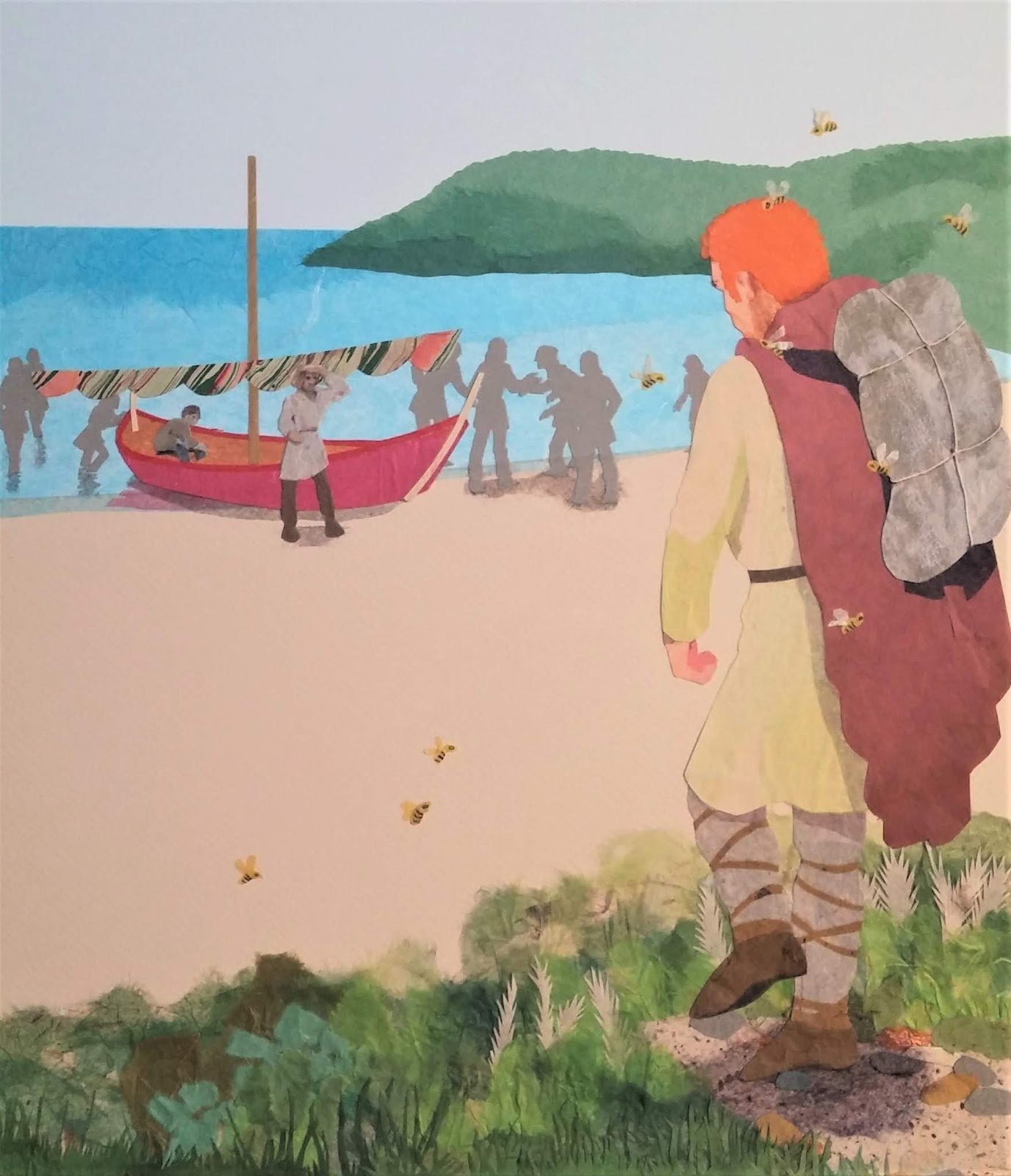
Modomnoc on his way to the boat that will carry him home to Ireland
It's nice to have some of my stories published, even if they are not exactly in the format I set them up for.  Fr. Aelred, who puts together the quarterly magazine for St. Andrew's Abbey, was asking one day if there were female oblates who had work to put into the magazine.  I happened to be there, and asked him if he would entertain the idea of stories, rather than nonfiction articles.  He said Yes, and to send them to him electronically.  When he received them he said he would very much like to publish one.  So that happened last summer.  Then before Christmas he said he would like to put another one into the Winter issue.  I had to scurry to get pictures ready, but a deadline is always useful.  I got this picture and one other done for the Winter issue, to go with the two pictures already finished.

The magazine arrived in our mailbox yesterday.  Considering that the format I planned on is a book with 8.5" x 10" pages, and the Chronicle pages are 5.5" x 8.5", the words and pictures came out quite well.

This is the story of St. Modomnoc, a 7th century Irish lad who goes to Wales to study for the priesthood, and is made beekeeper for the abbey.  He makes such a deep and loving connection with the bees that when it is time for him to go back to Ireland,  all the bees follow him there.   

This image is of a specific place in Wales, a beach near Menevia Abbey where Modomnoc studied. It seems like the most likely place where Modomnoc's boat would have left from. 

Saturday, January 25, 2020

Illustrating

Illustrating a story is different from making a picture, which is different from being a good draw-er.  I was always a good draw-er, so I thought I could illustrate.  It turns out that the essential skill is only the first step, and not even absolutely necessary at that.  In fact, it can be a detriment because a person who is confident that their work looks good may tend to lean too heavily on how attractive the image is, and not delve into the internal issuesof storytelling.  How does the picture express the feel of the story?  How does it tell something that the words don't or can't tell?  How does the picture fit into the placement of text on the page?  How many pictures does a story need?  What events in the story do you choose to illustrate?  How do you make each page beautiful in itself?  (That was one of Seth's main considerations when he was making his comic book pages.)

It has taken me ten years of struggling with the process and the discipline to even begin to formulate these questions.  Clearly I am a slow learner.

But little by little I am making images for the stories I want to tell, and putting them together.  It's only by actually DOING that a person learns these things.  Without doing it, I think you always think that the rules don't actually apply to you.  You think your work is above, or at least outside the rules.  Learning humility seems to be a vital part of this process.
Here's an illustration for the story of Martin de Porres and the mice.  Initially the picture did not have pots or shelves in the background, and Martin did not have the tonsure (that peculiar monk's haircut).  I was just throwing out pictures for certain segments of the story, without seeing how it all fit together.  But, then I reread a book I have on Martin, and rewrote the story so that it was more true to his life, and was going to toss this picture.  I did however like the structure of the picture, how his finger and the mice are all pointed toward one place, and decided I could still use it if it were altered.  
Now it seems to fit better as the final image in the story.  

From now on, however, I'd like to make most of the images blend into the page a little bit more, and not be so very rectangular.  That's Seth's influence.  

Sunday, April 14, 2019

Roxy and the Crows

Crows are smart and funny.  They are also very social beasts, and they take care of each other.  I heard a story from a driver who witnessed this event, about a group of crows in the street, clearly distressed, who flapped and cawed, beseeching the driver of the car not to proceed until they had moved an injured crow to the side of the road.

For a project for an illustration class, I did this picture for an as yet unwritten story about our next door neighbor Roxy who is about seven years old, and St. Benedict's Prep School in Newark, NJ, and an injured crow.  Benedictines are great; I am a Benedictine oblate myself.  They have a serene way of understanding that good things take time and practice.  This school is a modern miracle, an educational oasis in the middle of downtown Newark.  And Roxy is so full of energy that it was hard to picture her sitting still, though she is an animal lover, and so I am pretty sure she could do it if a crow's well-being was at stake.


Here is Roxy in a more characteristic pose, twirling in joy. 


Wednesday, July 4, 2018

Naming the Animals

Adam names the animals

God loves to create.  He made animals of shapes and color combinations and processes that we could not have imagined.

At an illustrators' workshop a few years ago I met Iain McCaig whose job it was at that time (I don't know if it is still his job) to design monsters for George Lucas.  Design creatures: what a job!  Talk about playing God!  Because it's a monster, by definition a creature unencumbered by reality, the boundaries are wide open, and one is limited only by imagination.  Iain showed us how he freed his mind from the strictures of an unimaginative day or not enough caffein that morning.  He led us through a process that used objects at hand to reimagine as monster parts, and challenged us to design our own monster.  It was great fun, and when we were finished I had drawn a creature that I would not have imagined without using his method.

God did it (does he still do it?) his own way, from scratch.  There is a niche that needs a creature, and he finds a way to fill it, always with panache. 

Adam in this picture has not yet eaten the awful fruit.  He is a simple, straightforward, guileless man who has been given the joyful mandate to give names to all the animals as they parade before him.  He gives them names and so asserts his stewardship over them. 

I tried to include in this picture as many genres of animals as I could without getting confusing, and still have an elephant as the centerpiece.  (Could a picture of animals in general NOT include an elephant?)  So there are mammals, birds (one extinct), reptiles, and an insect.  They have to stand in for all the animals that are outside the border of this picture. 

Thursday, October 20, 2016

Cut paper art


It has been nearly a year since I've posted anything here, so maybe it's time to put up a representative sample of the kind of work that I've done lately.  This is St. Martin de Porres, a Dominican monk from Peru in the early 16th century, a man of prayer who was known as a healer, but did not stop there.  He also cared for animals large and small.  The most famous small story about him concerns some mice that had overrun the monastery.  He invited them to live outside the walls in a place he designated, and they followed his suggestion, solving the monastery's problem while doing providing the mice with a proper home.

Working with cut paper is quite a different process from any work where one fills in a drawing with color from a brush or pencil.  First of all, there are the many gorgeous papers to choose from. Textures, colors, varying translucence, the papers bring their own personalities to the work.  It's like working in collaboration with a group of artists who all love beauty.

Then the size of the picture makes a difference.  I can't do details that are too fine; they would just be lost.  I have found that just redoing a watercolor picture in cut paper doesn't really work well.  The sort of image that watercolor does best is quite different from the sort of image that cut paper does well.  Sometimes there is energy in a scene that I would not have been able to express in watercolor, but can do with cut paper.  Perspective doesn't seem to be as big an issue with these works; they will never be photorealistic in any case; I can let them suggest rather than show the action.

This work to me now is a pleasure and a joy.  I hope that translates to others.  

Sunday, November 15, 2015

Collage

After doing about fifteen or so watercolor illustrations for stories about saints and animals, I got fed up because it was so laborious every time.  I would continually find other things to do than to face the unfinished page that was sitting on my work table.
When I had a personal sort of project to do however, like a birthday card, I would find some pieces of colored paper, cut out shapes, and make a picture out of them, bang, bang.  No matter how complicated or time-consuming these cut paper projects are, I head to the art table to work on them whenever there is a spare moment,
For example:
This one on the left is the card for Tofu's birthday this year.  The boy (Tofu, of course) has a wheel behind his feet so that he can move fairly easily up the path to the top.
It was so fun to make.
I have been making cut paper collages since I was in college, always for fun.  I never considered them serious art.
Why not?

Finally a lightbulb went off! Maybe I could do the art for my book in a medium that I truly enjoy...
What seems Real about this process is that the layers are truly layered: the background is in the back and the foreground objects are pasted on top. What's more, each color is its own discrete entity.  It makes sense in a simple-minded, literal sort of way.  For some reason that seems thrilling.  Also the textures of the papers add an organic beauty that I couldn't have invented.  And the clean edges are, well, clean, crisp.  

So I am starting over from scratch, doing cut paper pictures instead of watercolor ones.  
In order to finish this project in my lifetime, I'll cut down the number of pictures, so that each story will have three at the most, instead of about eight.  
I posted earlier the watercolor that this one is replacing which can be seen here.  

I suspect that I am an engineer at heart.


Tuesday, January 28, 2014

St. Seraphim, second round

St. Seraphim needed a better picture than the last one, and he needed another post.

Regardless of how this picture looks, he was more than a guy who had a bear for a buddy. The reason for the bear's interest and lack of normal animal-human antipathy was that St. Seraphim had immersed himself in prayer to such an extent that his soul had lost its odor of corruption, if I may put it that way.  He seems to have purified his soul so that he was able to live as in Eden, in harmony with the natural world.  The famous passage in Isaiah says that "the wolf shall dwell with the lamb,...the cow and the bear shall graze,...and the lion shall eat straw like the ox."  Fierce creatures will be gentle, and they and humans will not fear each other.  These prophecies seem to come to fruition in the lives of people who devote themselves entirely to prayer.  And St. Seraphim was one of those.
A quotation from St. Seraphim:
"You cannot be too gentle, too kind.  Shun even to appear harsh in your treatment of each other.  Joy, radiant joy, streams from the face of him who gives and kindles joy in the heart of him who receives.  All condemnation is of the devil.  Never condemn each other."

Ah, that is the kind of world I would like to live in.


Thursday, January 2, 2014

St. Seraphim

We spent last weekend on retreat up at the monastery that we love: St. Andrew's Abbey.  While we were there, I told someone about my plan for a book about saints and animals, and she said, "Well, there's Saint Seraphim and the bear..."  So when I got home I looked him up.
Saint Seraphim was a Russian monk who lived in a monastery, but in order to spend more time alone in prayer, took to staying in a small hut in the forest near his monastery.   He died in 1833, so he began going to the forest about the same time that Russia was at war with Napoleon.  Now Bob and I are reading WAR AND PEACE, and the War in this case is that war with Napoleon.  The Peace in the novel is a story of the social comings and goings, loves and trials of some fictional  Russian aristocrats.  For me there is something of a cognitive dissonance in the realization that this peaceable, prayerful man is the historical person, and the scheming, hoping, worrying, planning, good and bad motives and activities of the Bolkonskis, Rostovs, and Bezukhovs is fiction.   Tsar Alexander (who makes several appearances in the novel) was one of the people who visited St. Seraphim at his forest retreat.
The account of the bear is not really a story; it is just that while St. Seraphim lived in his hut in the forest, he was visited by many forest creatures whom he welcomed, as he welcomed all beings created by God.  An abbess from a nearby convent came to visit him one time and was terrified to see a huge bear with him.  But Seraphim told her not to worry, the bear wouldn't hurt her.  The bear was seen with him on various occasions.  He fed the bear with his bread, and was brought gifts of honey from the bear as well.

This little picture is a 5"x 7" card that I painted to send to Tofu, to tell him about this lovely, holy man.  His feast day, it turns out, is today, January 2.

Sunday, November 3, 2013

St. Gerasimos, the Lion, and the Donkey

This is a lovely old story, a legend about a saint who is a favorite in the Eastern Orthodox church.  St. Gerasimos is out walking in the Jordan River valley, when he comes across a lion, limping and holding one paw up pathetically.  The lion holds his paw out to the saint, who sits down, examines the paw, removes a large thorn, and binds up the paw with a clean cloth.  Then the lion follows him back to the monastery and stays there, whereupon the monks give the lion a job.

I won't tell the whole story here, (You can read about it here.) but I retold it, painted three illustrations for it, and it has been published (with one illustration) in a small Catholic children's magazine called St. Mary's Messenger.  The story is in the Fall 2013 issue, which just came out.


Monday, July 8, 2013

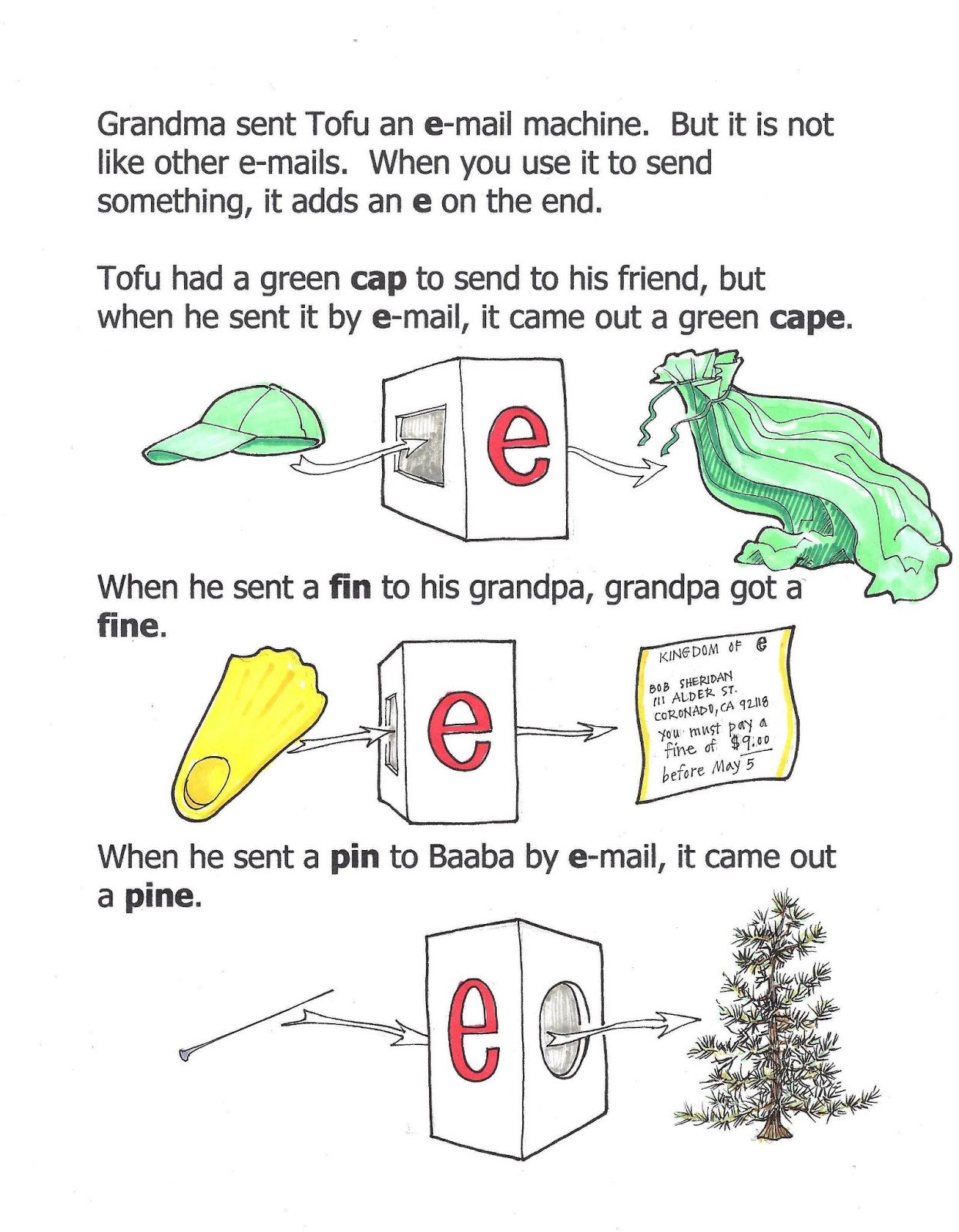
More English reading lessons for Tofu

 As Tofu's Japanese reading gets better and better, it becomes harder and harder for him to put himself through the effort of reading English, in which the pronunciation of the words is not necessarily obvious, and the content is necessarily somewhat elementary, since his reading vocabulary is so much smaller than his speaking vocabulary, and smaller yet than his thinking processes.

And of course eventually he will learn to read English in school, since Japanese schoolchildren do learn.  But he will learn from someone whose English skill is far less than his own.

So I think that it is a challenge well worth our effort, Tofu's and mine, to keep working on English reading. My challenge is to make lessons that are fun, not too simplistic, that he will enjoy enough to look forward to--not dread--letters from Grandma.  His challenge is to read them.

This particular rule, about how an "e" on the end of a word makes the vowel say its name, is one that he actually already knows.  But occasionally he stumbles over it, and so I thought it was worthwhile to make a whole interesting lesson on the subject.  Besides it was quite fun to find words that worked for this exercise.                                                                      

Tuesday, January 8, 2013

Good Dog

The Chinese (not Japanese) characters behind the boy say "Good dog" (at least that's what I hope.  The left hand one is Good and the right one is Dog.  If they would use a different way to say it in Chinese, I wouldn't know.).  This was the initial painting for a book that I am hoping to finish the illustrations for this year.  It's a true story of finding a puppy lost and cold on the streets of China, and bringing her home to America.

In fact, however, I don't expect to use this picture for the book.  I'd like the actual drawings to be somewhat simpler and flatter.  Also, the format will be different from this, with square pages.  So the image to illustrate this page, where the boy explains to the now grown-up dog that she came from China, will be a double page spread, twice as wide as high, and the text will be incorporated in the picture.  

But I liked this image.  I used my former next door neighbor boy Tate as a model for the boy in the picture.  He patiently posed for me, holding a stuffed dog and talking to it to try & get in the mood.

Monday, November 19, 2012

The little Nativity book is available on Amazon


In spite of the sign that says, "Click to look inside," the image to the left is not a link.  Here is the link to the site on Amazon.
Thanks to the hard work and persistence of my friend Dana Chisholm, the words I put together to tell the Christmas story, along with the pictures I painted, are all  gathered together into a book.  It is amazing and wonderful, and I am looking forward to holding the book in my hands.

I have much more to learn about both writing and illustrating.  Having something actually in print makes me eager to learn all I can, and do more. 

Saturday, March 24, 2012

Working things out

I have a series of stories to illustrate about a group of kids who live in Texas in the 1950's.  Nice, kind of slow moving stories, with conflicts, but not the kind of dire conflicts kids today face.  Their conflicts are more about simple getting along with one another.  One of these stories concerns the summer pleasures of floating down a stream on inner tubes.  After deciding on the general look of the picture, I started drawing it.
Here is the drawing:
I liked it pretty well, except that each of the people in it was as though they were in their own box--no overlapping, except for the two at the right, and the two of them were sort of in their own box.  Besides, the boy at the front, falling off his tube, looks not quite right.  And then, the deciding factor was that I reread the story and found that according to the words they are all supposed to be wearing shoes. 
It is always good training to be willing to do the drawing over and over again; it's something I learned from Seth.  Don't let it go out unless it is as good as you can do

So here is the second one:

Shoes on, some overlap, much better. 
Although the boy on the left, with the tube under his arm, has a left arm that is far too long...
And the boy splashing in the water still looks a bit disjointed.

Then I spoke with the author, who said that he had decided to give each of the drawings a full page in the book.  That means a vertical, rather than a horizontal layout. 
OK, no problem.  I'll draw it again. 


This time, for the vertical layout, I thought I'd better do a little more research on rivers, how they look, how water looks when it is flowing.  Doing it all from the imagination is fine, but it may be better to get some real feel for the landscape. 
Here is the third drawing:
OK.  I like the scenery much better.  It looks like a real place.  The little patch of reeds and grasses in the front right corner brings the viewer into the setting some more, all the kids have arms and legs in proportion. 
But there is a different problem: it's dull.  Nothing is happening.  Something is GOING to happen, as the boy with his back toward us is just about to hit the rapids, but everyone else is just floating.  Besides all the kids except one are in a vertical line.  Accuracy in drawing can NOT take the place of interest--either interesting composition, or interesting emotional action.  Accuracy is good, but for an illustration it has to take a back seat to emotion and vibrant composition.
Then I reread the story one more time, and found that there was some action in it that I had ignored.  In the girl in the plaid shirt teases the boy ahead of her by splashing him as they float along.


So below is what I think is the final:
It has action, accuracy, rhythm, and, I hope, interest.  I may find something else it needs, and if so, I'll change it again.  Or if anyone who sees this is bothered by something, I would be glad to hear about it.  I learn something every try. 


Sunday, March 18, 2012

Moses and Pharoah's daughter

Continuing to illustrate the handouts for my sixth grade Sunday school classes.  The subject matter is always available, the kids like the drawings, and I have an ongoing, low-pressure commission.  If I decide later that my skills have increased so that I can depict the story better, I'll redo it for next year.     

Thursday, January 19, 2012

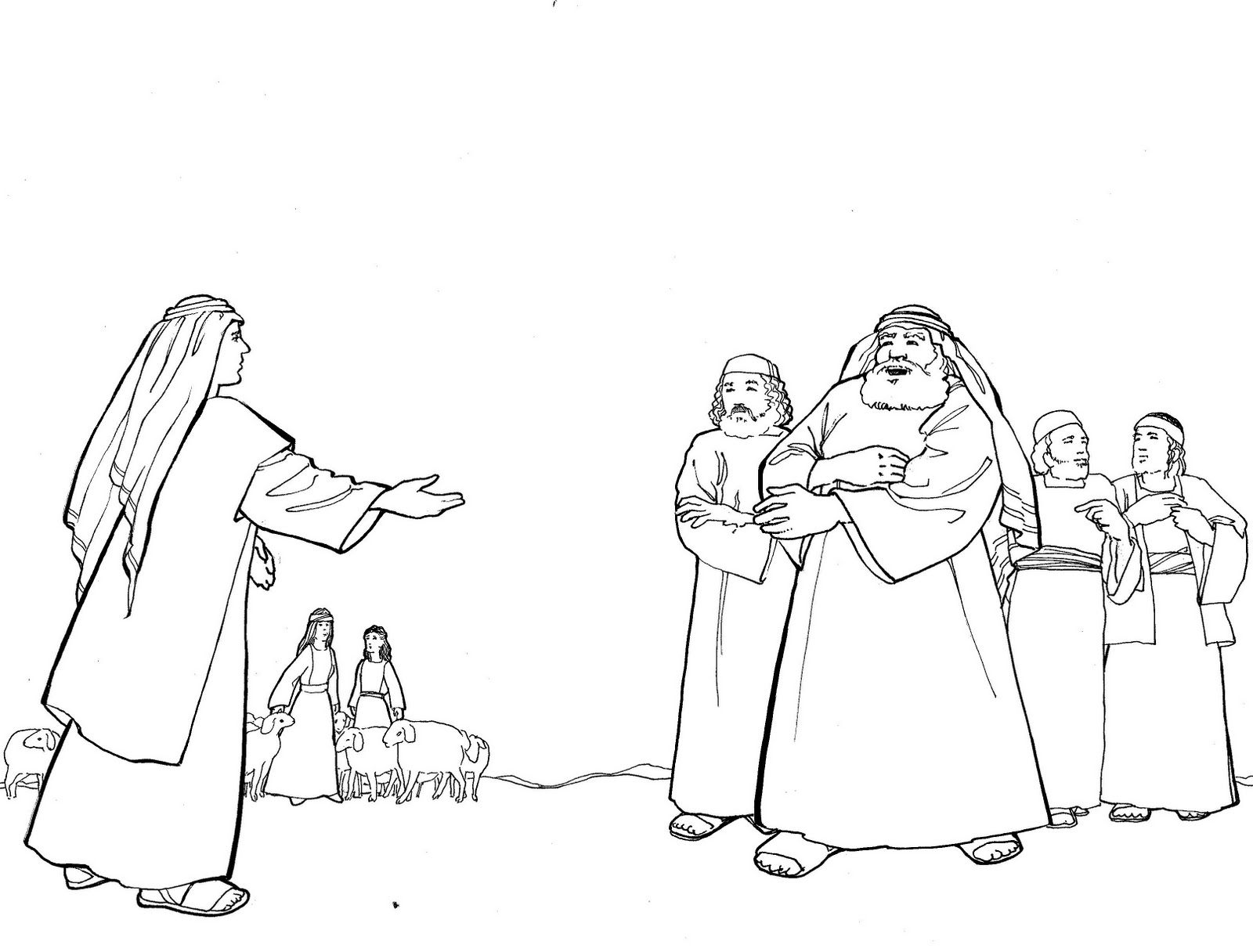
Jacob the Trickster meets his match in Uncle Laban

Genesis 25 begins the story of Jacob and his twin brother Esau.  Though they are twins, Esau is older, and thus stands to inherit everything from his father Isaac, including the covenant with God.  Jacob tricks his father into giving him the inheritance instead and then runs for his life to his mother's brother Laban, a man whose ability and willingness to deceive are even greater than his own.  It's a colorful and fascinating story about a man who would do ANYTHING to be blessed.  He is wrong-headed, and God teaches him a hard lesson, but his goals are in the right place. 
This is the first drawing that I have for this story for my class.  Laban's sons are behind him, and his daughters are under Jacob's outstretched arm.

Monday, November 21, 2011

Abraham and Isaac


ABRAHAM AND ISAAC
My Sunday school class gets first crack at my pen and ink drawings, though I don't tell them I did them.  They don't need to know that.

In this story, Abraham has been called by God to offer his only son Isaac as a sacrifice.  Abraham sets off to do his grim duty, determined to follow the instructions of the God of the universe, no matter how counter it seems to everything that has passed before.
Of course, once he has proved that he was willing, God stops him and tells him to offer a ram instead. 

I won't go into the theology of this story here though, just the art.   Abraham is old and determined; Isaac is young and trusting, but puzzled. 

Thursday, November 17, 2011

Bible illustrating

THE ANGELS URGE LOT AND HIS FAMILY TO FLEE SODOM
For my sixth grade Sunday school class in Old Testament, since we use only the bible as our textbook, I try to provide some visuals for the kids. 
I may not actually use this piece, because it's really rather a minor story, but I am trying to learn to do pictures with more action in them, and this scene was full of action.  Sodom is about to be destroyed, and the two angels (looking like regular travelers) are trying to convince Lot's family that it is urgent that they leave NOW.

Looking at the work of some of the great illustrators: Howard Pyle, N C Wyeth, Seth Fisher, and I see tension, bodies in movement, and then I looked at my pictures, and they were all quite still.  I realized I needed to learn to portray the tension that is at the heart of a story where there is high emotion and high stakes.

When I started doing watercolors, I thought I was pretty much putting pen and ink aside.  But I do really love line drawings.  And for this purpose, for handouts to my students, I can copy these on the school copier, so black and white works where color would not.   

Monday, September 19, 2011

Promo postcard, take two

It really helps to have some critique from a friend you can trust, someone with a good eye who knows what good illustration can be, and doesn't let you get away with doing less than the best you can do. 

Using the same basic idea (and some of the same books), I redid the postcard.  I am much more satisfied with this one.  Besides that, I won't have to put any information on the back: it's all on the front.